
EDI System Maintenance: Cleaning Triggers, Procedures and Feedwater Limits
EDI system maintenance has two jobs: keep the feedwater inside the module manufacturer’s limits, and use logged trends to decide when a stack needs cleaning. Most EDI problems start upstream. Hardness, silica, CO2, oxidants or organics reach the stack, and performance drifts until resistivity, voltage or pressure drop moves outside its normal range.
Cleaning can remove scale and organic or biological fouling. It cannot repair membranes or resin damaged by oxidants, overheating or wrong chemicals. This guide follows IONPURE and E-Cell manufacturer documents. Limits, recipes and sequences differ between module families, so confirm every value against the manual for the installed module before you act on it.
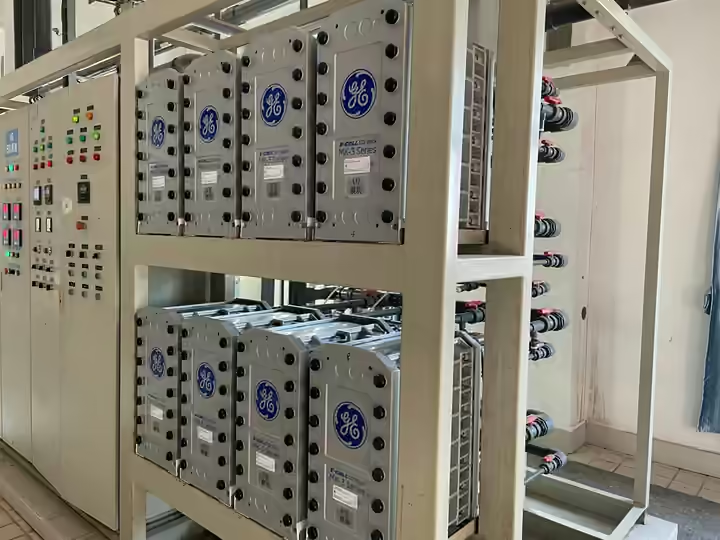
What should be logged every day on an EDI system?
A daily log is the basis for every maintenance decision. One reading tells you little; a trend shows whether the stack, the feedwater or an instrument has changed. The IONPURE LX manual asks operators to log the following parameters, and some of them are required to keep the warranty.
| Group | Parameters | Why it matters |
|---|---|---|
| Feedwater | Temperature, conductivity, hardness, total chlorine, CO2 | Shows whether the RO permeate still meets the EDI feed limits |
| Product | Product resistivity; silica where it is specified | The result the EDI is installed to deliver |
| Electrical | DC voltage, DC current, calculated module resistance | Rising resistance often points to scale in the concentrate side |
| Hydraulic | Product and reject flows; dilute and concentrate inlet and outlet pressures; both differential pressures | Rising pressure drop indicates particulate, biological or scale fouling |
Temperature changes module resistance and product quality. Compare readings at similar feed temperature, or use temperature-normalized values, before concluding that the stack has fouled. Check instrument calibration as well: the IONPURE LX manual lists instrument recalibration, wiring checks, interlock tests and leak checks among its six-monthly tasks.
When does an EDI module need cleaning?
Clean when the logged trend crosses the manufacturer’s criteria, not on a fixed calendar. The IONPURE LX manual gives the following triggers, assessed when temperature and flow (and, for product quality, feed conductivity) have not changed.
| Indicator | Change indicating cleaning | Likely cause to investigate first |
|---|---|---|
| Product (dilute) differential pressure | Increase of 25% | Particulates, resin fines, biofilm |
| Reject (concentrate) differential pressure | Increase of 50% | Hardness scale or biofouling in the concentrate compartments |
| Module electrical resistance | Increase of 50%, normalized for feed temperature | Hardness scale; low concentrate flow |
| Product quality | Decline with no change in temperature, flow or feed conductivity | Fouling, scaling, or feed CO2/silica above design |
Source and scope: IONPURE, IONPURE LX CEDI Modules: Operation & Maintenance Manual, IP-MAN-LX-0426-EN, Rev 5, April 2026, Section 6.3. These values apply to the LX module family. For E-Cell stacks and other modules, use the owner’s manual for the installed stack.
Before you clean, rule out the causes cleaning will not fix. Low product resistivity after an RO upset, a CO2 increase in the feed, a failed DC power supply or a drifting resistivity sensor can all look like a fouled stack.
Which feedwater limits protect an EDI system?
EDI is designed to polish RO permeate. Its feed limits are much tighter than those of an RO system, and exceeding them is the most common reason a stack scales, fouls or loses performance. The table compares two widely used module families.
| Parameter | IONPURE LX modules | E-Cell MK-3 stack |
|---|---|---|
| Total hardness (as CaCO3) | ≤ 1.0 ppm | ≤ 1.0 ppm in counter-current operation; 0.1 ppm in co-current operation |
| Silica (SiO2) | ≤ 1.0 ppm | ≤ 1.0 ppm; 0.5 ppm when hardness exceeds 0.5 ppm |
| Total chlorine | ≤ 0.02 ppm (EU, X, HI); ≤ 0.05 ppm (Z) | ≤ 0.05 ppm; other oxidizing agents not detectable |
| Iron, manganese, sulfide | ≤ 0.01 ppm | ≤ 0.01 ppm each |
| TOC (as C) | ≤ 0.5 ppm | ≤ 0.5 ppm |
| Ionic load | Feed conductivity equivalent (FCE) ≤ 40 µS/cm, including CO2 and silica | TEA ≤ 63.6 ppm as CaCO3; conductivity equivalent ≤ 109 µS/cm, confirmed in Winflows |
| pH | 4–11 | 4–11 |
| Temperature | 5–45 °C (HI: 5–60 °C) | 4.4–40 °C |
| Inlet pressure | ≤ 6.9 bar | ≤ 6.9 bar |
Sources and scope: IONPURE LX manual IP-MAN-LX-0426-EN Rev 5, Table 2-3; Veolia E-Cell MK-3 Stack Fact Sheet, FS1622EN, June 2023. The E-Cell ionic-load limits are stated at minimum flow and maximum temperature and must be checked in the manufacturer’s projection software for the actual design. Older stacks and other models can have different limits. GlobalUF also supplies systems with Chinese-made EDI modules; their limits come from the respective manufacturer’s documents.
In practice, protecting the EDI means controlling what happens upstream:
- Hardness and silica: keep the RO system’s rejection, recovery and antiscalant dosing within design. A two-pass RO or a softener ahead of the RO is common where feed hardness is high. Scale in the RO is a warning sign for the EDI; see RO membrane scaling causes and prevention.
- CO2: dissolved CO2 passes the RO and loads the EDI’s anion resin. Degassing or pH adjustment ahead of the second RO pass reduces it.
- Oxidants: chlorine and other oxidants damage ion-exchange membranes and resin. Verify dechlorination continuously, not occasionally; see how to prevent membrane oxidation.
- Particulates and bacteria: the EDI feed should be RO permeate or equivalent. Open tanks, degassers and long pipe runs between the RO and EDI can recontaminate the water. Veolia specifies a filter, generally 5 µm absolute or 1 µm nominal, ahead of E-Cell stacks fed from an open system.
Where UF sits ahead of the RO, include its transmembrane pressure and cleaning results in the review as well; see how to clean fouled UF membranes.
What chemicals are used to clean an EDI module?
EDI cleaning chemistry is specific to the module. Do not transfer an RO or UF cleaning recipe to an EDI stack. The IONPURE LX manual specifies the following solutions.
| Problem | Solution | Notes |
|---|---|---|
| Hardness scale, metal oxides | Hydrochloric acid (HCl), 2% | pH maintained at 0.5–1.0 during circulation |
| Organic fouling, biofilm | Sodium chloride 5% / sodium hydroxide 1% | Preceded by a salt (brine) flush to displace hardness |
| Organics, pressure drop, sanitizing | Sodium percarbonate, 1.5% | Preceded by a salt flush and water rinse |
| Routine sanitizing | Peracetic acid, diluted per the manual | Preceded by a salt flush and water rinse |
| Heavy biofouling | Multi-agent sequence: caustic, percarbonate, brine, then acid | Used when single-agent cleaning is not enough |
| Thermal sanitization | Hot water, 80–90 °C, about 1 hour | LX-HI modules only; DC power off |
Source and scope: IONPURE LX manual IP-MAN-LX-0426-EN Rev 5, Sections 6.2 and 6.6–6.9. Recipe quantities depend on module size and are given per module in the manual. E-Cell stacks have their own cleaning procedures in the E-Cell owner’s manual.
When it is unclear whether a stack has scaled or fouled, the IONPURE manual’s sequence is a brine flush, the NaCl/NaOH solution, a second brine flush, then HCl. The manual notes that, where organics are present, high-pH cleaning before the acid step may be more effective. Mixing acid and caustic directly is not part of any sequence: the stack is flushed between low-pH and high-pH steps.
Chemical grade matters too. Use the grades the manual specifies, check compatibility of every wetted part, including the CIP tank, pump, hoses and gaskets, and follow the chemical supplier’s safety data sheet. The general planning steps for a cleaning skid are covered in our guide to membrane CIP systems.
What is the typical EDI cleaning sequence?
The steps below summarize the structure of a cleaning in the IONPURE LX manual. They are not a valve sequence and they do not replace the procedure for the installed module.
- Prepare. Confirm the diagnosis and the approved recipe. Pressure-test the CIP circuit with water, flush the hoses and rinse the tank before adding chemicals.
- Isolate and switch off DC power. DC power must be off for the whole cleaning or sanitization.
- Flush. Carry out the salt or water flush the selected recipe requires.
- Circulate. Recirculate the solution for 30–60 minutes, with product flow at nominal and reject flow at about half the product flow. Keep the CIP pump discharge between 2 and 6.9 bar. Check solution pH where the recipe requires it.
- Displace and rinse. Flush between chemical steps, and flush for about 10 minutes after the final step.
- Return to service. Flush for at least 5 minutes before re-applying DC power. Divert product to drain until resistivity meets the specification.
- Dispose. Check pH before draining and neutralize spent solution as local regulations require.
Do not open a module, dead-head an outlet, or apply DC power before flow and pressure are confirmed. Record the actual concentrations, times, flows and temperatures; nominal settings are not enough to explain a poor result.
How do you know whether EDI cleaning worked?
Compare the stack against its own baseline under comparable conditions:
- Module resistance: temperature-normalized resistance should move back toward the post-commissioning or last-good value.
- Differential pressures: dilute and concentrate pressure drops at the same flows.
- Product quality: resistivity, and silica where it is specified, once the stack has stabilized.
- Durability: how quickly the trend deteriorates again.
If performance falls again within weeks, cleaning frequency is not the fix. Investigate the RO, the dosing and the water path between RO and EDI. If cleaning produces little recovery, review the cleaning record and consider whether the membranes or resin have been damaged.
What should be checked at startup, shutdown and storage?
- Startup: establish feed flow first, then energize DC power while flushing to drain, and send product to service only when quality is within specification.
- Shutdown: remove DC power and relieve pressure in the sequence the manual specifies.
- Short idle periods: avoid long stagnation. The IONPURE LX manual suggests rotating trains or flushing periodically, for example 10–15 minutes every 4–8 hours.
- Longer shutdowns (7 days or more): isolate the modules so the membranes and resin do not dry out, close or plug the connections to limit bacterial growth, and consider sanitizing before restart.
Frequently asked questions about EDI maintenance
How often should an EDI system be cleaned?
There is no universal interval. Clean when normalized resistance, pressure drop or product quality reaches the manufacturer’s criteria. A stack fed with well-controlled RO permeate may run for long periods between cleanings; a stack that needs frequent cleaning has a feedwater problem to find.
Can citric acid be used to remove scale from an EDI module?
The IONPURE LX procedures use hydrochloric acid for scale and metal oxides. Do not substitute another acid unless the module manufacturer’s manual permits it for that model.
Should DC power stay on during cleaning?
No. The IONPURE LX manual requires DC power to be off during chemical cleaning and hot water sanitization, with a flush of at least 5 minutes before power is restored.
Can an EDI system tolerate chlorine in the feed?
Only at trace levels within the specification: 0.02–0.05 ppm total chlorine, depending on the module. Continuous oxidant exposure damages the ion-exchange materials, and cleaning cannot reverse it.
Does cleaning restore an EDI module to new condition?
No. Cleaning removes deposits. Damage from oxidants, overheating, overpressure or incompatible chemicals is permanent, and the affected module may need replacement.
What information should you send for an EDI system review?
GlobalUF provides on-site EDI cleaning, system audits of the RO and EDI train, and support for OEMs integrating EDI into their own systems. To review an existing system, send:
- The module brand, model and quantity, and the system’s design flow
- Recent daily logs: feed conductivity, CO2, hardness, product resistivity, voltage, current and pressures
- The RO configuration, chemical dosing and the equipment between RO and EDI
- Previous cleaning records and the current symptoms
These details let us judge whether the problem is in the stack, the feedwater or the instrumentation before a cleaning is planned. For new projects, see GlobalUF’s EDI systems.
Request a Quote
Fill out the form below to discuss your water treatment needs. Our experts will get back to you within 24 hours.
You may also be interested in:

Choosing Pumps and Energy Recovery for Small Containerized Seawater RO Plants

What Information Do You Need Before Requesting an RO System Quotation?

How to Remove Iron from Borehole Water in Tanzania and East Africa

Seawater Desalination Pretreatment: When to Choose Media Filters or UF

Tiered Strategies for Water Hardness Removal

What Is a Membrane CIP System? RO and UF Cleaning Triggers and Planning

Understanding Scaling and Backpressure in Reverse Osmosis Systems

How to Purify Borehole Water for Drinking: Testing, Treatment and Verification

What Is Hard Water? Hardness Levels, Standards and Removal Methods


