What is a Membrane CIP System? The Ultimate Guide for Plant Managers and Technicians
Introduction: The “Internal Medicine” of Water Treatment
If the membranes in your Reverse Osmosis (RO) or Ultrafiltration (UF) system are the “heart” of your industrial water plant, then the Membrane CIP (Clean-In-Place) System is the essential medical kit that keeps that heart beating.
In large-scale desalination and industrial water treatment, performance decline isn’t a matter of “if,” but “when.” Scaling, organic fouling, and bio-growth are constant threats. If you’ve noticed a drop in permeate flow or a spike in differential pressure, you are likely facing membrane fouling.
In this comprehensive guide, we will break down what a CIP system is, how it works for both UF and RO, and why it is the most critical investment for reducing operational expenditure (OPEX).
1. What Exactly is a Membrane CIP System?
A Clean-In-Place (CIP) system is a dedicated skid designed to clean membrane elements without removing them from their pressure vessels or the system framework.
Through the controlled circulation of specialized chemical cleaning in water treatment, the CIP system removes contaminants that physical backwashing cannot reach. It is a closed-loop process that restores the membrane’s flux (flow rate) and salt rejection capabilities to near-original levels.

2. Why Your Plant Cannot Survive Without a Robust CIP
As a plant manager, you know that membrane replacement is one of the highest capital costs. A well-executed CIP strategy offers three main values:
- Extended Membrane Lifespan: Regular cleaning prevents “irreversible fouling,” stretching the life of your RO/UF elements from 2 years to 5+ years.
- Energy Efficiency: Fouled membranes require higher feed pressure to produce the same amount of water. Higher pressure = higher electricity bills.
- System Reliability: For desalination plants, a CIP system ensures that your output remains constant despite seasonal changes in raw water quality.
3. Key Components of a CIP System
A standard industrial-grade CIP skid isn’t just a tank and a pump. To be effective, it must include:
- CIP Chemical Tank: Usually made of PE or FRP to withstand aggressive low/high pH chemicals.
- CIP Pump: A low-pressure, high-flow pump designed to provide enough “cross-flow velocity” to scour the membrane surface.
- Cartridge Filter (5-10 micron): To ensure that loosened debris doesn’t get recirculated back into the membranes.
- Heater/Heat Exchanger: Critical for RO. Most chemical reactions (especially for organic removal) are significantly more effective at temperatures between 30°C and 35°C.
- Instrumentation: pH meters, temperature sensors, and flow meters to monitor the cleaning efficiency in real-time.
4. UF vs. RO: How CIP Strategies Differ
While the hardware looks similar, the “medical prescription” (the chemicals) changes depending on whether you are cleaning an Ultrafiltration or a Reverse Osmosis system.
Ultrafiltration (UF) Cleaning
UF membranes typically face surface fouling from suspended solids and bacteria.
- Chemicals: Often uses Sodium Hypochlorite (NaOCl) for bio-fouling and Citric Acid for inorganic scaling.
- Frequency: More frequent (daily or weekly) as “Chemically Enhanced Backwash” (CEB) or monthly full CIP.
Reverse Osmosis (RO) Cleaning
RO membranes suffer from deep-seated scaling (Calcium Carbonate, Silica) and organic fouling.
- Low pH Cleaning (pH 2-3): Uses acids (like Citric or hydrochloric acid) to dissolve mineral scales like CaCO3.
- High pH Cleaning (pH 11-12): Uses alkaline cleaners (like NaOH) and surfactants to break down oils, silica, and biological slime.
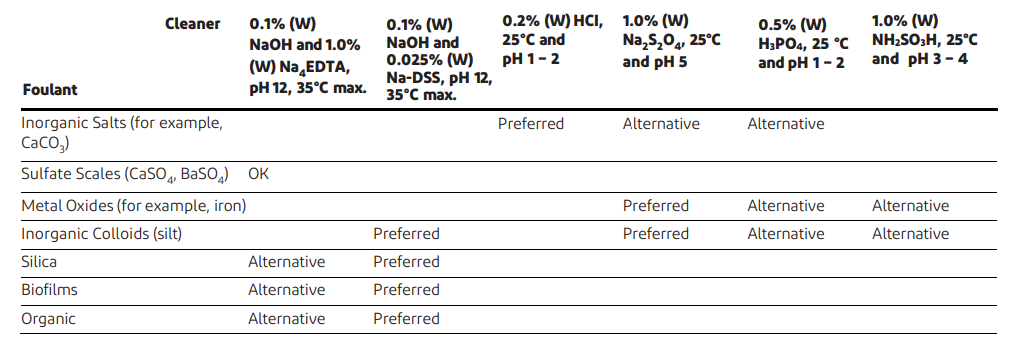

For detailed operational procedures and specific dosage calculations, please refer to the industry gold standard(P137): FilmTec™ Reverse Osmosis Membranes Technical Manual
5. The Step-by-Step CIP Procedure
For technicians on the floor, following a disciplined sequence is the difference between a successful recovery and a damaged membrane.
- Mixing: Prepare the cleaning solution in the CIP tank using RO permeate or high-quality demineralized water.
- Displacement: Pump the cleaning solution into the pressure vessels, displacing the residual feed water to the drain.
- Recirculation: Circulate the chemicals through the membranes. Note: Always discard the first 10-20% of the solution if it returns extremely turbid.
- Soaking: The most underrated step. Let the membranes soak for 1 to 8 hours (depending on fouling severity) to allow the chemicals to penetrate the foulant layer.
- High-Flow Pumping: Increase the flow rate to “flush out” the loosened particles.
- Final Rinse: Use RO permeate to flush the chemicals out of the system before going back into “Service” mode.
6. Pro-Tips for Optimizing Your CIP Performance
As an engineer, I often see plants “over-cleaning” or “under-cleaning.” Here is how to get it right:
- Don’t Wait Too Long: The “10% Rule.” Initiate a CIP when the normalized permeate flow drops by 10%, or the differential pressure ($\Delta P$) increases by 15%. If you wait for a 30% drop, the fouling might be permanent.
- Monitor pH Constantly: During an acid clean, if the pH rises above 4, it means the acid is “spent” (consumed by the scale). You must add more acid to keep it at pH 2-3.
- Check for “Telescoping”: If your CIP pump pressure is too high, you risk physically damaging the RO elements (telescoping). Always follow the manufacturer’s max pressure limits.
7. Conclusion: Investing in Long-Term Stability
A Membrane CIP system is not just an auxiliary piece of equipment; it is an insurance policy for your water treatment plant. Whether you are managing a seawater desalination facility or an industrial process water loop, mastering chemical cleaning in water treatment is the key to operational excellence.
By maintaining a clean system, you reduce downtime, protect your assets, and ensure your facility meets its water quality targets every single day.
Watch Our Membrane CIP Skid in Action
See how a high-performance Clean-In-Place (CIP) system operates. This video provides a detailed walkthrough of the Globaluf CIP skid, highlighting the chemical circulation process, the precision control panel for pH and temperature monitoring, and the robust components engineered to restore your UF and RO membrane performance.
Need a Custom CIP Solution?
Are you struggling with persistent membrane fouling or looking to upgrade your current CIP skid? Our team at Globaluf specializes in designing high-efficiency UF and RO systems tailored to challenging water conditions.
Request a Quote
Fill out the form below to discuss your water treatment needs. Our experts will get back to you within 24 hours.
You may also be interested in:

Conquering Red Water: How to Treat High-Iron Borehole Water in Tanzania and East Africa

Integrated Pretreatment Strategies for Seawater Desalination: Protecting Your RO Investment

Tiered Strategies for Water Hardness Removal

Understanding Scaling and Backpressure in Reverse Osmosis Systems

How to Purify Borehole Water for Drinking

What is Hard Water and How to Remove Hardness From It?

The Hidden Threat: Your Expert Guide to Preventing RO Membrane Biofouling

The Silent Killer of RO Systems: A Complete Guide to Preventing Membrane Oxidation

How to Desalinate Sea Water: The Ultimate Guide to SWRO Technology