5 Notable BWRO Desalination Projects and Their Design Lessons
Brackish water reverse osmosis (BWRO) uses pressure-driven membranes to reduce dissolved salts in suitable brackish sources. Feedwater chemistry, temperature and system design affect membrane performance; a capacity figure or TDS reading alone does not describe a complete treatment system. DuPont: RO technology
This guide examines five selected project references: Al Wasia, El Atabal, Buwaib and Salboukh, Zara–Ma’in, and the Kay Bailey Hutchison plant. The aim is to help EPC contractors, system integrators and project owners ask better questions about pretreatment, capacity, maintenance and concentrate management.
These are engineering references, not a verified ranking of the world’s five largest plants. One entry covers two related sites. Published figures refer to different project phases and capacity definitions, so they should not be treated as directly comparable current operating outputs. These international references are not presented as GlobalUF deliveries or evidence of GlobalUF involvement.
For a project in the 100–2,000 m³/day RO permeate range, explore GlobalUF skid-mounted BWRO systems alongside the project lessons below.
Five BWRO Project References at a Glance
| Project reference | Location | Published figure and its scope | Main lesson for project planning |
|---|---|---|---|
| Al Wasia | Saudi Arabia | 200,000 m³/day in WABAG’s project reference | Design pretreatment and RO together. |
| El Atabal | Spain | 165,000 m³/day in the historical SUEZ design reference; EMASA subsequently reported a 2023 expansion | Keep original design, completed upgrades and future targets separate. |
| Buwaib and Salboukh | Saudi Arabia | Two separate expansion references of 60,000 m³/day each, not a verified present-day combined site capacity | Define the scope and phase of an upgrade. |
| Zara–Ma’in / Wadi Ma’in, Zara and Mujib | Jordan | SAJDI’s project reference describes 47 million m³/year; a September 2026 ministry statement reports about 38 million m³/year of production | Distinguish project supply references from reported production, and include conveyance. |
| Kay Bailey Hutchison | United States | Up to 27.5 MGD total plant freshwater capacity; five RO trains rated at 3 MGD each | Distinguish total plant supply from RO permeate capacity. |
Sources and qualifications for each figure are provided in the corresponding project section. MGD means million US gallons per day. No energy-efficiency or recovery ranking is implied by this table.
1. Al Wasia, Saudi Arabia: Pretreatment Is Part of the Desalination Design
Al Wasia illustrates why a BWRO project cannot be reduced to membrane racks and pumps. WABAG identifies a 200,000 m³/day project for AZIZ Company on behalf of the Ministry of Agriculture. Its reference describes an extension to existing pretreatment, with lime softening, cooling towers, filtration and two-stage RO. WABAG project reference
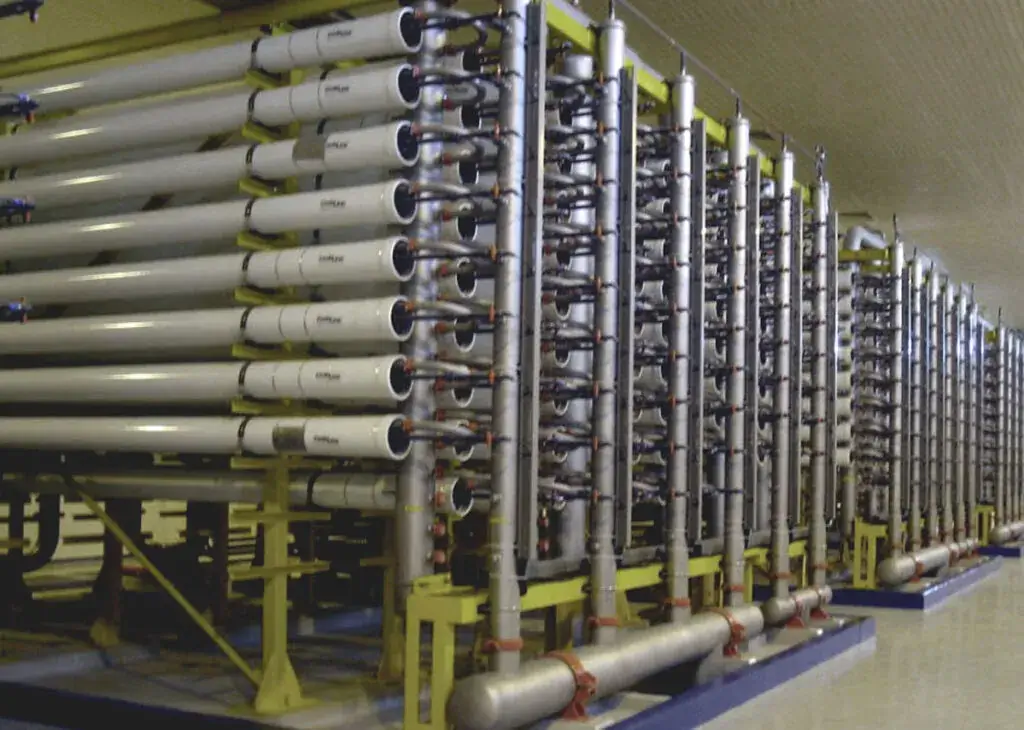
The practical lesson is to establish what the source water requires before selecting the RO package. For your project, ask whether hardness control, temperature conditioning, filtration and associated residuals handling belong in the same proposal or in a separate package.
Cooling towers and lime softening are features of this reference, not standard requirements for every borehole-water system. Likewise, the project’s published recovery or product-water figures should not become default commitments for another water source.
2. El Atabal, Spain: Separate Design Performance from Upgrade Targets
El Atabal demonstrates the importance of pretreatment integration and clearly defined RO staging. SUEZ’s historical reference describes 165,000 m³/day, existing clarification and sand filtration before RO, and a two-stage arrangement in which the second stage treats first-stage concentrate. It reports 80% water recovery for that design. SUEZ / Degrémont reference

The historical figure is not an assertion of the plant’s current installed capacity. EMASA reported a completed expansion in March 2023 that increased production capacity by 12%. This article does not calculate a new total from percentages and figures published under different descriptions. EMASA: 2023 expansion
There is also a more recent development. In September 2026, EMASA announced the award of design-assistance work for SITAguaS, an efficiency initiative aiming to reduce reject water from 20% to 10%. That is a project objective, not evidence that the target has already been achieved. EMASA: September 2026 project update
For buyers, the lesson is to ask whether a quoted number is an original design value, a completed upgrade result or a proposed improvement. Recovery and energy figures are meaningful only with their operating conditions and measurement boundaries.
3. Buwaib and Salboukh, Saudi Arabia: Define the Upgrade Boundary
A capacity listed for an expansion should not automatically be treated as the present capacity of an entire site. AlKawther’s project register lists a 60,000 m³/day Buwaib expansion completed in 2009 and a separate 60,000 m³/day Salboukh expansion completed in 2008. These are historical project-scope references, not confirmation of today’s combined operating capacity. AlKawther project register

For an existing BWRO facility, define which assets will remain, which will be replaced and which will be added. The review should cover the pretreatment capacity, pumps, pressure vessels, instruments, controls, pipework and concentrate route—not just the new membranes.
Ask the supplier to identify the performance boundary for the upgraded package and the assumptions about retained equipment. This is particularly important where an existing plant must remain partly operational during modifications.
4. Zara–Ma’in, Jordan: Include Water Conveyance in the Project
A desalination plant’s delivery infrastructure can be as important to the project scope as its treatment equipment. SAJDI’s Wadi Ma’in, Zara and Mujib reference describes a project supply figure of 47 million m³ per year, a 41 km conveyance pipeline, pumping stations and reservoirs. SAJDI project reference
A September 2026 statement from Jordan’s Water Ministry, published by Petra, reports approximately 38 million m³ of annual production and describes pumping-system rehabilitation. The two publications use different descriptions and contexts. Their figures are retained separately here rather than converted into a single asserted daily nameplate capacity. Petra: ministry statement, 23 September 2026

For a smaller project, define where the supplier’s responsibility ends: at the RO permeate outlet, at a storage tank or at a downstream delivery point. Include transfer pumping, elevation changes, storage and distribution requirements when comparing project scope. An RO-skid quotation alone is not a quotation for the complete water-supply system.
5. Kay Bailey Hutchison, United States: Clarify Capacity and Concentrate Management
The Kay Bailey Hutchison plant shows why total water-supply capacity and RO membrane capacity must be stated separately. El Paso Water publishes up to 27.5 MGD of freshwater capacity and identifies five RO trains, each designed for 3 MGD. The RO-train ratings therefore total 15 MGD, rather than 27.5 MGD. The operator also identifies production wells and blend wells supplying the facility. El Paso Water: desalination

For reference, 27.5 MGD is approximately 104,100 m³/day, while 15 MGD is approximately 56,800 m³/day. These are US-gallon conversions of differently defined flows, not interchangeable equipment ratings.
El Paso Water describes concentrate conveyance to a deep-well injection facility approximately 22 miles from the plant. That arrangement is a project-specific reference, not a recommendation to use the same disposal route elsewhere. El Paso Water: concentrate handling
The buyer’s lesson is to define both the required water-delivery boundary and the concentrate-management responsibility before comparing quotations.
Applying These Lessons to a 100–2,000 m³/day BWRO Project
The useful takeaway from large BWRO plants is a set of design questions—not a scaled-down copy of their membrane arrangement or performance figures.
Define the Required Water Quantity
State whether your daily requirement means RO permeate, water after blending or net water delivered to the user. Then specify the actual production hours.
Required hourly permeate flow = required daily permeate volume ÷ daily production hours.
For example, a requirement of 1,000 m³/day over 20 production hours equals 50 m³/h of permeate. This arithmetic example does not include allowances for downtime or internal water use, and it does not establish feedwater flow or recovery.
Make Water Analysis the Starting Point
Provide the source, a recent water analysis and expected seasonal variation. Ask the design team to identify the data that determine pretreatment, material selection, membrane selection and operating limits.
Temperature, pH, salt concentration and recovery affect RO performance. Published performance from another project should therefore be treated as a reference, not as the expected outcome for your source. DuPont: RO performance factors
Specify Operation, Maintenance and Site Interfaces
Decide whether the project requires one treatment unit, independent parallel units or separately specified standby capacity. Multiple skids do not by themselves define how much water remains available during maintenance.
Ask for a scope that distinguishes the RO assembly from pretreatment, dosing, cleaning equipment, storage, external piping, electrical connections and installation support. Identify who will handle concentrate and other process residuals.
Compare Proposals on the Same Basis
Use the same water analysis, permeate requirement, production hours and target water specification for every quotation. Compare equipment and support boundaries alongside price.
Ask suppliers to distinguish design projections, factory test conditions and site acceptance criteria. A result obtained under one set of conditions should not be presented as proof of performance under another.
Explore a Project-Specific GlobalUF BWRO Configuration
GlobalUF supplies water-treatment equipment and membrane-system integration for industrial, commercial and project customers. For projects targeting 100–2,000 m³/day of RO permeate, the skid-mounted BWRO product page provides a starting point for discussing capacity, configuration and enquiry requirements.
A separate containerized BWRO option can be evaluated where an enclosure forms part of the requested equipment package. Neither delivery format should be assumed to include all site works or an unconditional water-quality guarantee.
Start with Your Water Analysis and Project Requirements
To discuss a BWRO proposal, please provide your feedwater analysis, required capacity, target water quality or application, daily operating hours, electrical supply, and automation or material preferences. Please also identify the project location and intended concentrate-management route.
Discuss your BWRO project with GlobalUF
Email: sales@globaluf.com
Phone: +86 136 8225 6901
Final equipment selection, performance commitments and supply responsibilities are defined in the project proposal and contract.
Request a Quote
Fill out the form below to discuss your water treatment needs. Our experts will get back to you within 24 hours.
You may also be interested in:

How to Choose a Containerized RO System for Islands and Remote Sites

Exploring the Top 5 SWRO Desalination Plants in the World(2025)

How to Choose Brackish RO Membrane for Your Desalination Plant