In the world of Seawater RO desalination(SWRO), the Reverse Osmosis (RO) membrane is the heart of the system. However, the performance and lifespan of these expensive membranes are entirely dependent on what happens before the water reaches them. Seawater is a complex matrix of dissolved salts, suspended solids, organic matter, and microorganisms—all of which pose a severe threat of membrane fouling and scaling.
At Globaluf, we believe that a robust Seawater Desalination Pretreatment strategy is not just a technical necessity; it is a critical economic decision to reduce Operational Expenditure (OPEX) and ensure long-term system stability.
Tiered Strategies for Seawater Pretreatment
To achieve consistent water quality, we categorize pretreatment into three essential levels of protection.
Level 1: Source Water Intake & Macro-Screening
The first line of defense involves managing the intake of raw seawater. Whether using open-sea intakes or beach wells, macro-screening is vital to remove large debris, seaweed, and marine organisms that can damage high-pressure pumps.
Level 2: Conventional Physical-Chemical Treatment
For seawater with high turbidity or seasonal algae blooms, conventional treatment remains a reliable foundation.
Coagulation & Flocculation: Destabilizing colloidal particles to form larger flocs.
Media Filtration (DMF/MMF): Utilizing layers of anthracite and quartz sand to intercept suspended solids.
Multi-layer media filtration tanks used for initial turbidity reduction in large-scale desalination plants.
As discussed in our detailed UF technical guide, Ultrafiltration (UF) has become the gold standard for high-end desalination projects. It provides a physical barrier against bacteria, viruses, and fine colloids, delivering a consistently low Silt Density Index (SDI) regardless of raw water fluctuations.
Comparison: Media Filtration vs. Ultrafiltration (UF)
Choosing the right technology depends on your project’s specific footprint and raw water quality.
Feature
Conventional Media Filtration
Ultrafiltration (UF) Pretreatment
Effluent Quality (SDI)
Variable (4.0 – 5.0)
Consistent (< 3.0)
Footprint
Large (Requires more space)
Compact (Modular design)
Chemical Usage
High (Coagulants/Polymers)
Low (Periodic cleaning only)
Virus/Bacteria Removal
Partial
Complete Physical Barrier
Reliability
Susceptible to intake fluctuations
Stable during Algae Blooms
Critical Components of a Robust System
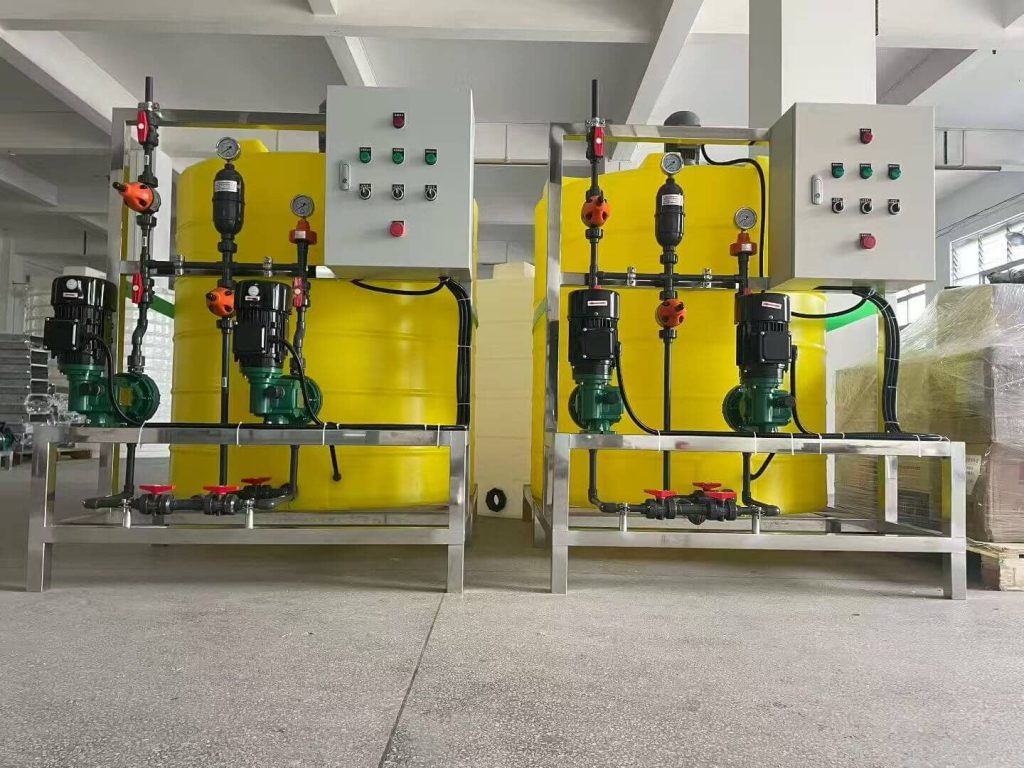
1. Intelligent Dosing Systems
Precision is key. Automated dosing of antiscalants, bisulfites (for dechlorination), and acids ensures the pH and chemical balance are optimized to prevent scale formation on the RO membranes.
This image depicts an advanced seawater desalination system equipped with a chemical dosing unit for optimized performance.
2. The Role of Ultrafiltration Modules
Utilizing high-flux UF modules allows for a smaller system footprint while maintaining superior protection. By removing the organic “food” for bacteria, UF significantly delays biofouling—one of the most difficult challenges in desalination.
High-performance UF membrane array serving as the final barrier before the RO process.
The Impact on ROI: Why Pretreatment Matters
Investing in advanced pretreatment might seem like a higher initial cost (CAPEX), but it pays for itself by:
Extending RO Membrane Life: Reducing replacement frequency from 2-3 years to 5+ years.
Lowering Energy Costs: Cleaner membranes require lower feed pressure.
Reducing Downtime: Fewer Clean-In-Place (CIP) cycles mean more production hours.
Conclusion
Seawater desalination is a journey of precision. From the initial intake to the final polishing, each pretreatment stage must be meticulously designed to handle the harsh marine environment. At Globaluf, we leverage over 20 years of expertise to design integrated systems that turn the most challenging seawater into a reliable resource.
🚀 Ready to Secure Your Desalination System?
Don’t let poor pretreatment compromise your RO performance. Globaluf offers end-to-end solutions from UF Membrane Modules to complete Pretreatment Skids.
If you operate a manufacturing plant, an agricultural farm, or a municipal water project in East Africa—particularly in Tanzania, Kenya, or Uganda—you are likely familiar with the “red water” curse.
A Selection Guide from Ion Exchange to Chemical Softening Engineer Hu’s Insight: In the lifecycle of industrial water supply, municipal systems, and wastewater reuse, controlling water hardness is a core
Introduction: The “Internal Medicine” of Water Treatment If the membranes in your Reverse Osmosis (RO) or Ultrafiltration (UF) system are the “heart” of your industrial water plant, then the Membrane
Reverse osmosis (RO) systems are integral to modern water treatment, but they can encounter issues like scaling and backpressure. Differentiating these can enhance system performance and reliability. Scaling in RO
Introduction Borehole water often serves as a vital source of water in areas without municipal supply. However, it may contain contaminants that need removal before it’s safe for drinking. This
Have you ever noticed a chalky white film on your glassware, or tasted a strange mineral flavor in your tea or coffee? The culprit is likely “hard water.” While common
Your reverse osmosis system was a star performer. Pressures were stable, flow rates were high, and water quality was perfect. Then, slowly but surely, things started to change. You find
What is RO Membrane Oxidation? Think of RO membrane oxidation as a chemical burn. TFC membranes, the standard for modern RO systems, have an ultra-thin polyamide layer responsible for salt
Introduction With freshwater scarcity becoming a global challenge, seawater desalination has emerged as a critical solution to provide clean, drinkable water. Among the various desalination technologies, Seawater Reverse Osmosis (SWRO)
Introduction In the world of water treatment, reverse osmosis (RO) systems are essential for producing high-quality purified water. However, one common challenge that plagues these systems is RO membrane scaling.